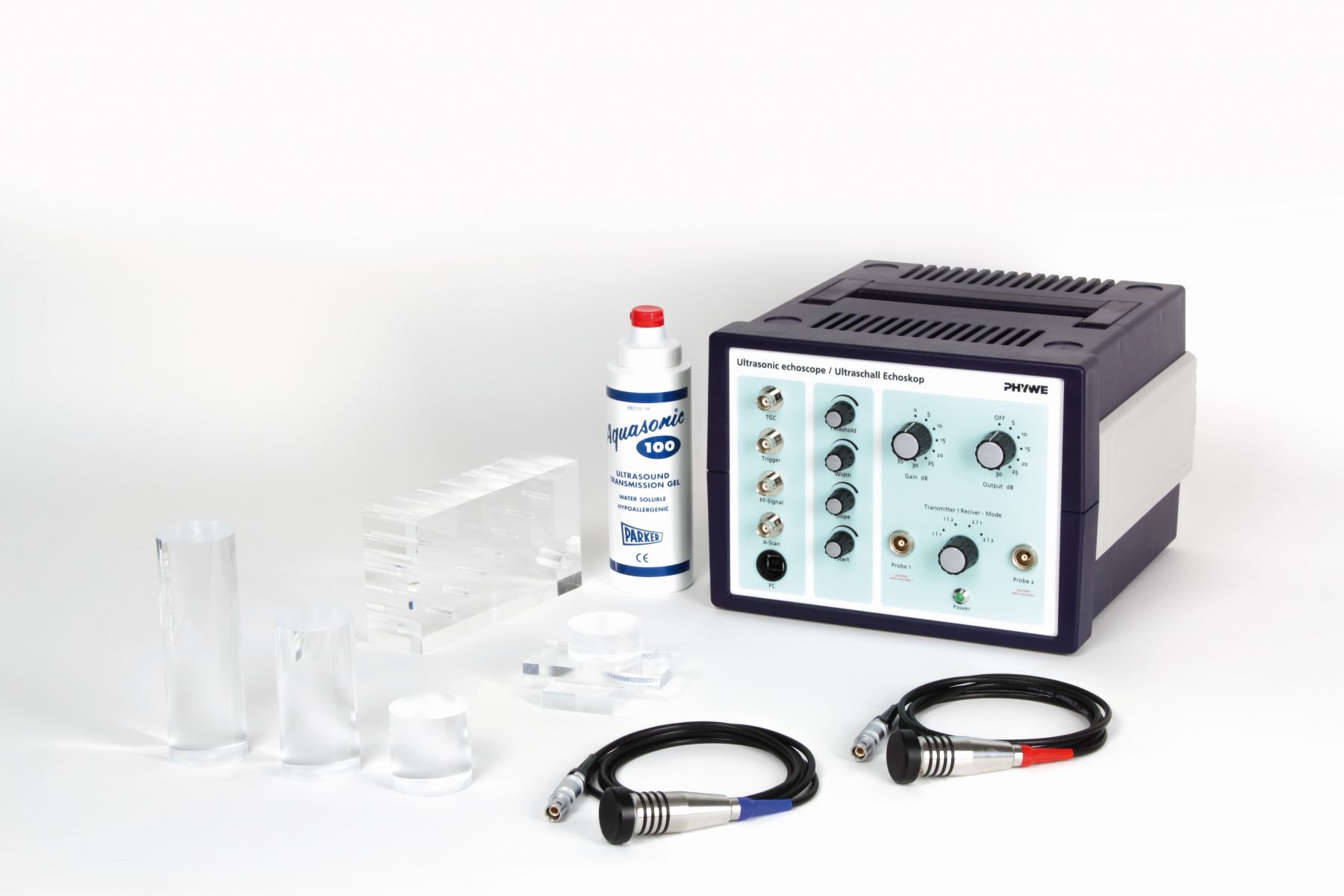
Basic Set Ultrasonic Echography II
With the ultrasonic echoscope the basics of ultrasound and its wave characteristics can be demonstrated. Terms like amplitude, frequency, sound velocity or Time Gain Control (TGC) will be explained. The cylinder set can be used to vividly demonstrate reflection as well as sound velocity and frequency depending on attenuation in solid state materials. The knowledge e.g. regarding sound velocity will be used to measure the test block. The principles of image formation from A-scan to B-scan can be explained. With the different probes the frequency-dependent resolution can be evaluated. The Ultrasonic echoscope is a highly sensitive ultrasonic measuring device designed to connect to a personal computer or simply to an oscilloscope The supplied software enables an extensive signal processing (RF-signal, amplitude signal, B-scan, M-mode, spectral analysis). The ultrasonic probes are connected by robust snap-in plugs. The probe frequency is recognised automatically by the measuring device. By adjusting the power transmission and gain the ultrasonic signal can be tuned to nearly every arbitrary object of investigation. The loss of intensity of the ultrasonic signal from deeper layers of investigation is balanced by a time-dependent amplification (TGC time-gain control). Threshold, start and end point or slope can be chosen freely. Important signals (trigger, TGC , RF signal and amplitude signal) are available at BNC outputs. Freely configurable measuring ranges (time of flight and/or depth). Selectable sampling rates of 10, 25, 50 or 100 MHz. Ultrasonic echoscope Ultrasonic probe 1 MHz Ultrasonic probe 2 MHz Ultrasonic test block Ultrasonic cylinder set Ultrasonic test plates Ultrasonic gel Size: 230 x 236 x 168 mm Frequency: 1 - 5 MHz PC connection: USB Measuring operations: reflection and transmission Transmitter signal: 0 - 300 V Transmitter power: 0 - 30 dB Gain: 0 - 35 dB TGC: 0 - 32 dB, threshold, slope, width, start Outputs: trigger, TGC, RF signal, A-scan Main voltage: 100-240 V, 50/60 Hz Power of electricity: max. 100 VA