Spatial encoding in Nuclear Magnetic Resonance
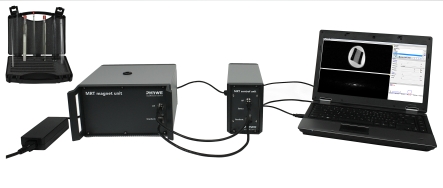
It should be demonstrated how spatial encoding does work in the MR technology. Experiments are executed with a MRT training device giving the opportunity ton investigate some small probes in the sample chamber. Device control is done with the provided software. Investigations comprise the generation of a 1D spatial encoding procedure via an additional magnetic field gradient in the driection of encoding and the visualizations of spatiotemporal T1- and T2-profiles. T1 and T2 are specific to the particular sample material and thus give important evidence for the composition of the subject of investigation. Complete, easy to install and affordable MRT education system One system to cover all aspects from NMR basics to sophisticated 2D and 3D imaging sequences Detailed experiment guides included with the system Learning results guaranteed thanks to easy to manage course steps Can be set up at any location in the student lab 1D spatial encoding via a magnetic field gradient (frequency coding). Visualization of spatiotemporal T1-profiles in spatial encoding direction. Visualization of spatiotemporal T2-profiles in spatial encoding direction. Nuclear spins Precession of nuclear spins Resonance condition, MR frequency MR flip angle FID signal (Free Induction Decay) Magnetic gradient fields Spatial encoding (frequency coding) Fast-Fourier-Transformation (FFT) T1/T2 relaxation times Spin-lattice relaxation Spin-spin relaxation Dephasing