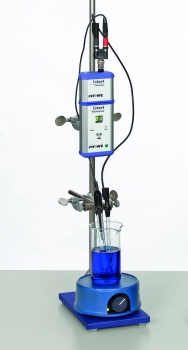
Briggs-Rauscher reaction with Cobra SMARTsense reaction
The Briggs-Rauscher reaction is a so-called homogeneous oscillating reaction, i.e. the reaction rate of the complete process is subject to periodic fluctuations. In general, oscillating reactions can always occur when the following conditions are fulfilled: The reaction must run highly exergonic (ΔG << 0). At least one of the reaction steps must contain a positive or negative back-coupling. Such back-coupling processes occur when the result of the individual partial steps of the reaction, such as changes in temperature or concentration, act back on the rate constants of the individual partial steps of the reaction. In this way, the whole reaction becomes non-linear. Simplified implementation: all pre-settings already prepared Spectacular experiment with numerous color changes Observer the fluctuations of the Briggs-Rauscher reaction by measuring the potential over a definite time period. Oscillating reactions Exergonic process Potential Briggs-Rauscher reaction Precision balance 620g/0.001g This experiment requires a computer. Software provided.
Need a curriculum quote? Contact our science education team at office@am-sci.com