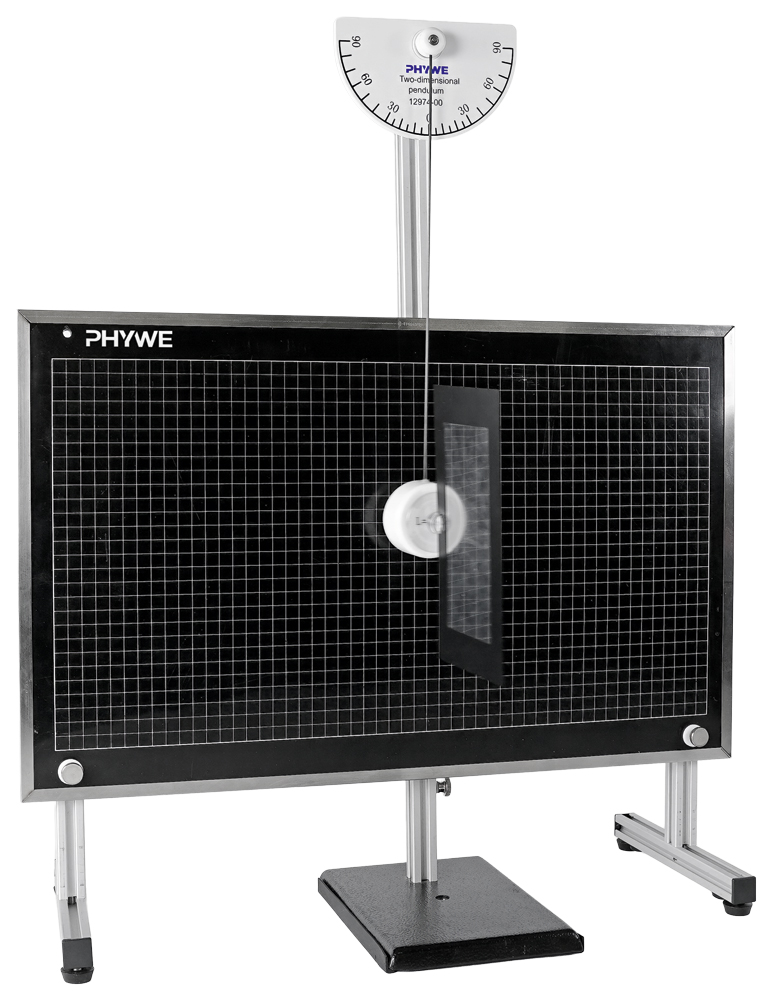
Damped Oscillation with Cobra DigiMotion
Article No: P6211000
Damped oscillation describes a realistic motion of a pendulum in which energy losses due to friction and air resistance are taken into account. As a result, the amplitude of the pendulum decreases over time until the system eventually comes to rest. With the MotionBoard, oscillations can be recorded precisely, allowing the decay of amplitude and damping parameters to be determined experimentally.TasksRecord the motion of string pendulums of different lengths using the MotionBoard.Measure the oscillation period of each pendulum.Repeat the experiment with different damping elements.Compare the oscillation periods with and without damping.Observe the decrease in amplitude.Learning objectivesStudents should recognize that oscillations are damped by friction and air resistance and that the amplitude decreases over time. They learn to determine damping parameters experimentally, understand the influence of damping elements on the oscillation period, and analyze the decrease in amplitude using diagrams. In doing so, they practice the quantitative analysis of oscillations and the application of mathematical descriptions of damped motion.BenefitsPrecise digital recording of oscillations in real timeClear demonstration of damping due to air resistance and frictionDirect comparability of different damping strengthsPromotion of data analysis, diagram interpretation, and experimental accuracyIdeal for lower and upper secondary education
Need a curriculum quote? Contact our science education team at office@am-sci.com