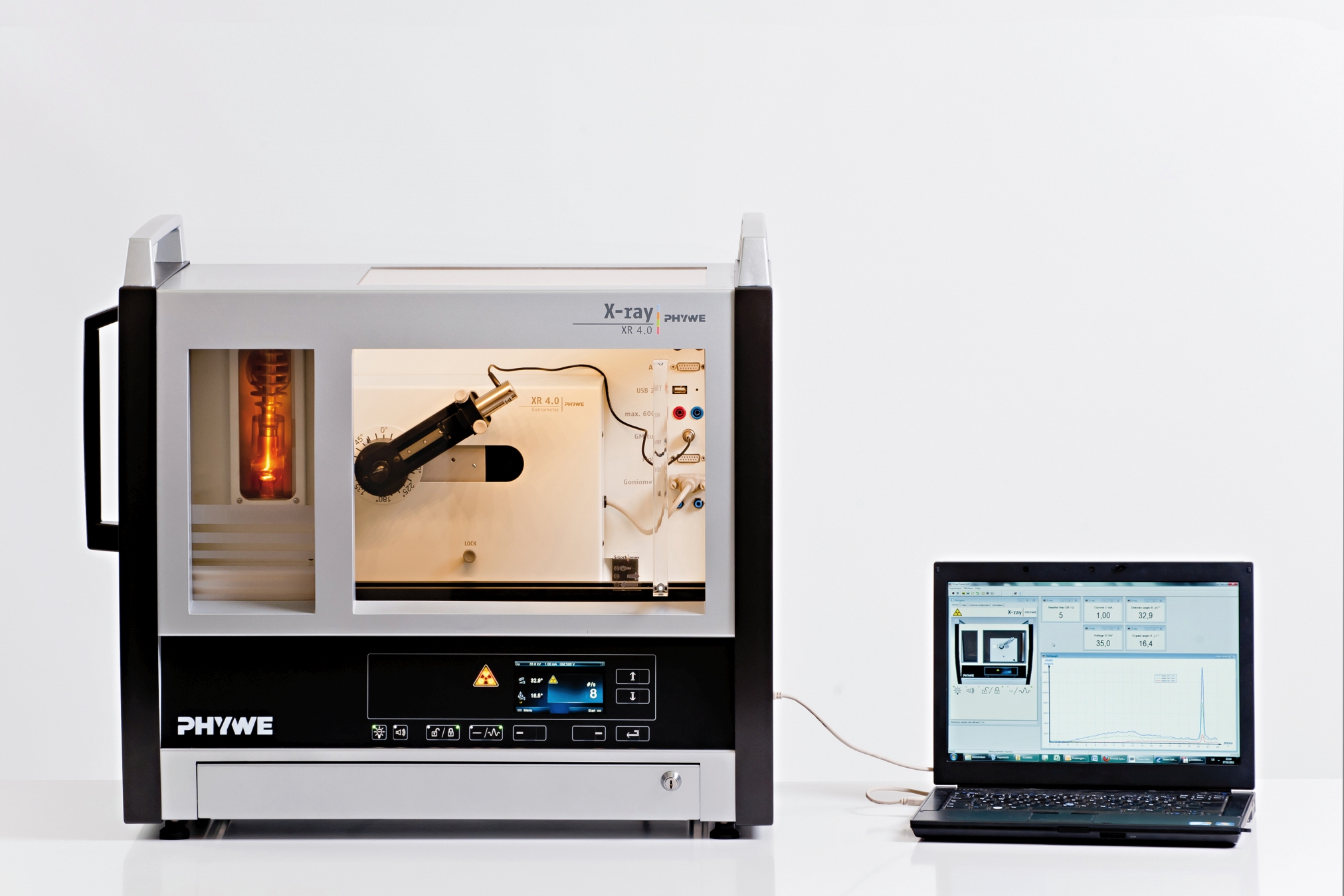
Duane-Hunt displacement law and Planck's "quantum of action"
Article No: P2540905
X-ray spectra are recorded as a function of the anode voltage. The short wavelength limit of the bremsspectrum is used to determine the agreement with the Duane-Hunt displacement law, and to determine Planck's "quantum of action". Record the intensity of the X-rays emitted by the copper anode at various anode voltages as a function of the Bragg angle using an LiF monocrystal. Determine the short wavelength limit (= maximum energy) of the bremsspectrum for the spectra obtained in (1). Use the results to verify the Duane-Hunt displacement law, and to determine Planck's "quantum of action". X-ray tube Bremsstrahlung Characteristic X-ray radiation Energy levels Crystal structures Lattice constant Interference Bragg equation