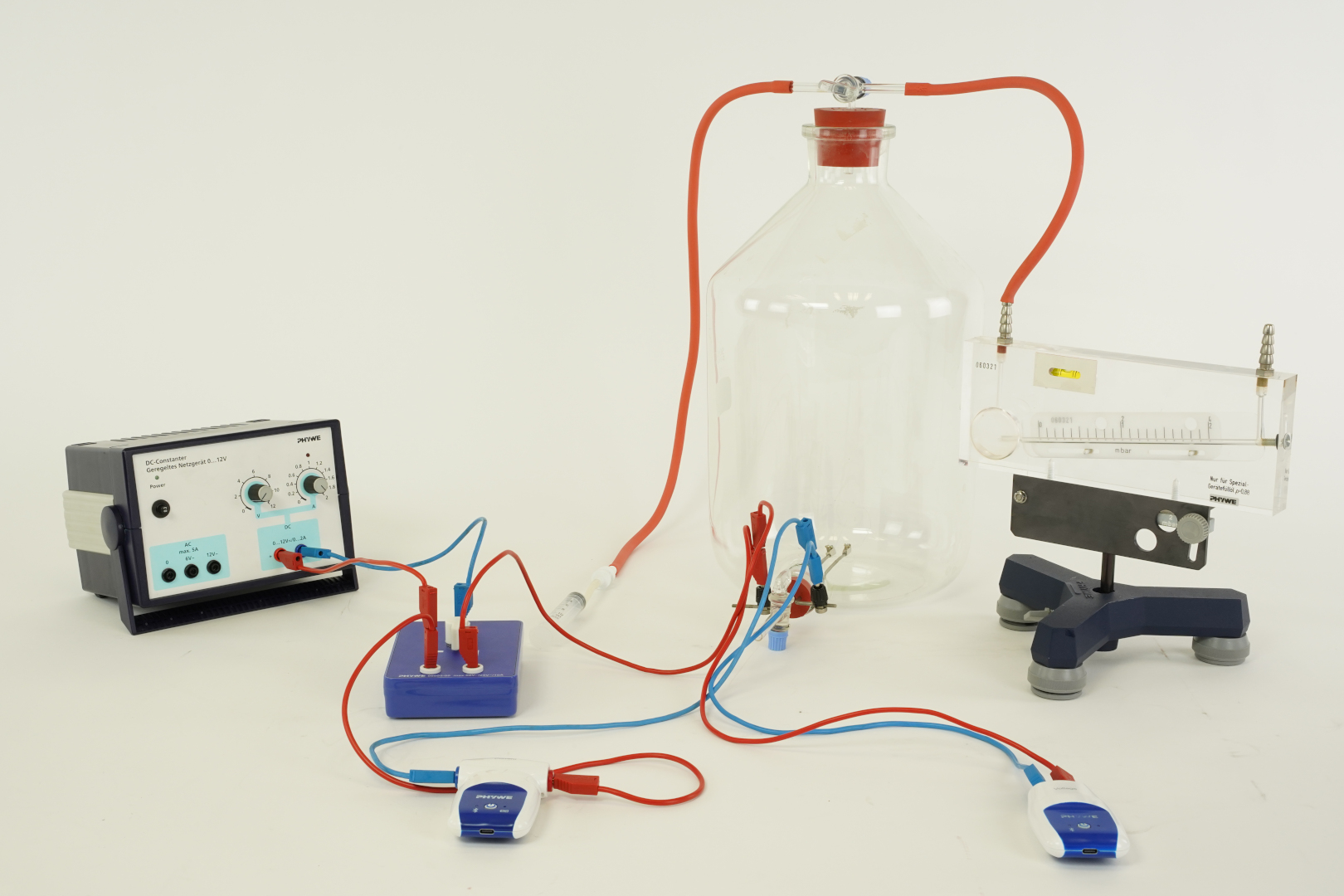
Heat capacity of gases with Cobra SMARTsense
Article No: P2320267
Heat is added to a gas in a glass vessel by an electric heater which is switched on briefly. The temperature increase results in a pressure increase, which is measured with a manometer. Under isobaric conditions a temperature increase results in a volume dilatation, which can be read from a gas syringe. The molar heat capacities are calculated from the pressure or volume change. Determination of cp and cv For both demonstration and student experiments Suitable for many different gases Simplified implementation: all pre-settings already prepared Determine the molar heat capacities of air at constant volume and at constant pressure. Equation of state for ideal gases 1st law of thermodynamics Universal gas constant Degree of freedom Mole volumes Isobars Isotherms Isochors and adiabatic changes of state Software included. Computer not provided.
Need a curriculum quote? Contact our science education team at office@am-sci.com