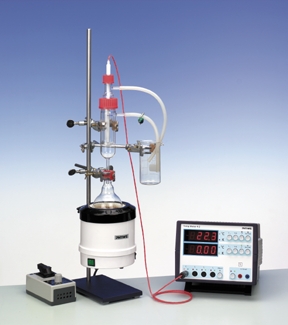
Boiling point elevation - Raoult's law
Article No: P3021001
The boiling point of a solution is always higher than that of the pure solvent. The dependence of the temperature difference (elevated boiling point) on the concentration of the solute can be determined using a suitable apparatus. Benefits Simple presentation and execution by temperature meter 4-2 Simultaneous display of current temperature and temperature difference Compact, easily transportable setup Tasks Measure the increase in the boiling point of water as a function of the concentration of table salt, urea and hydroquinone. Investigate the relationship between the increase in boiling point and the number of pellets. Determine the molar mass of the solute from the relationship between the increase in boiling point and the concentration. Learning objectives Raoult's law Henry's law Ebullioscopic constants Chemical potential Gibbs-Helmholtz equation Concentration ratio Degree of dissociation Necessary accessories Precision balance 620g/0.001g