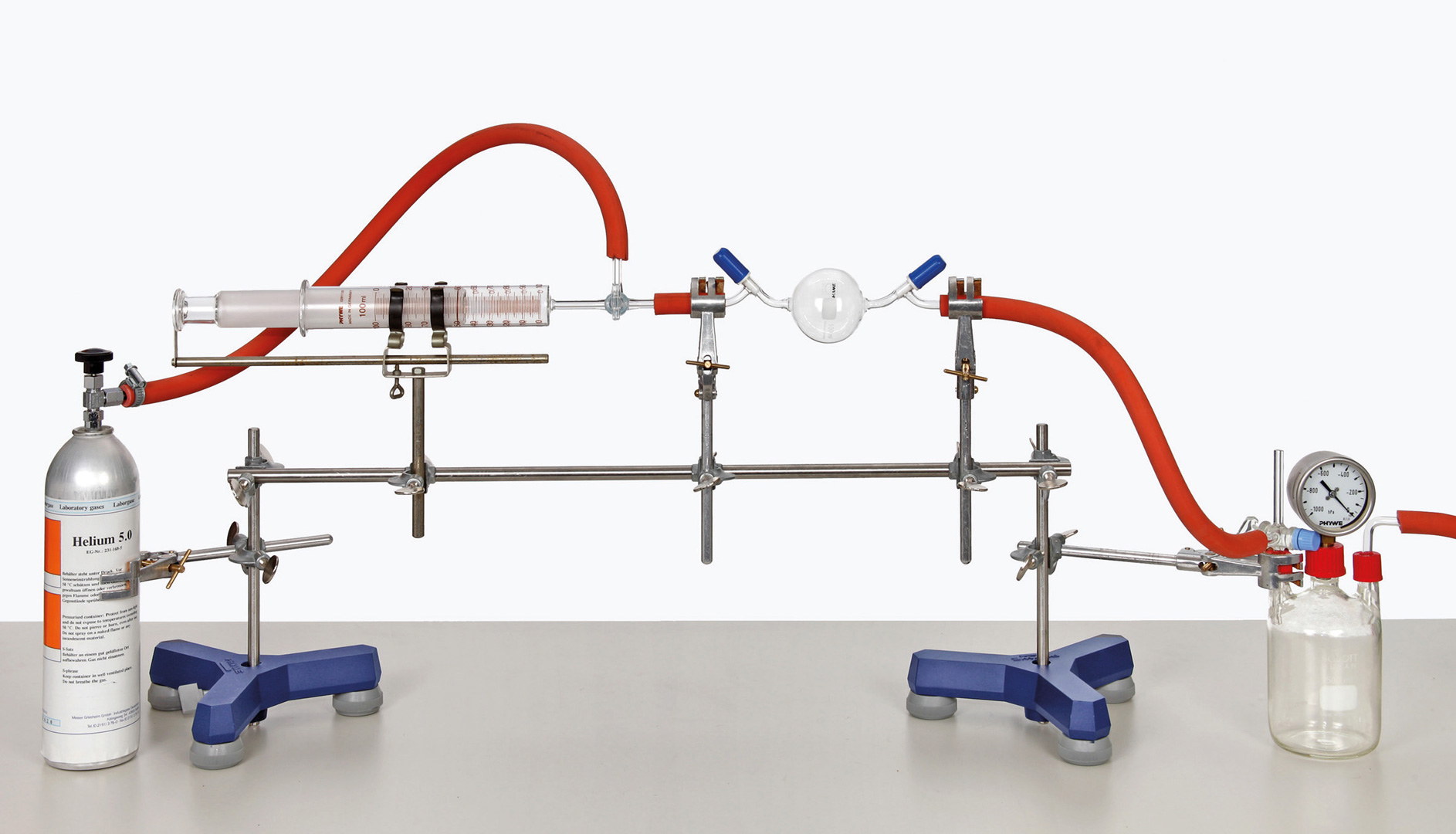
Determination of molar mass using the ideal gas law
Article No: P3010401
All gases may be considered, to a first approximation, to obey the ideal gas equation which relates the pressure p, volume V, temperature T and amount of substance n of a gas. The amount of gas n is expressed as the number of moles and is equal to m / M where m is the mass of gas present and M is the mass of one mole of the gas. The volume occupied by a known mass of gas is to be measured at a given temperature and pressure, so that the ideal gas equation can be used to estimate the molar mass of the gas. Benefits Examination of many different gases possible Illustrative experimental setup Tasks Determine the molar masses of the gases helium, nitrogen, carbon dioxide and methane. Learning objectives Molar mass and relative molar mass Properties of gases Ideal and ordinary gases Equations of state Necessary accessories Precision balance 620g/0.001g