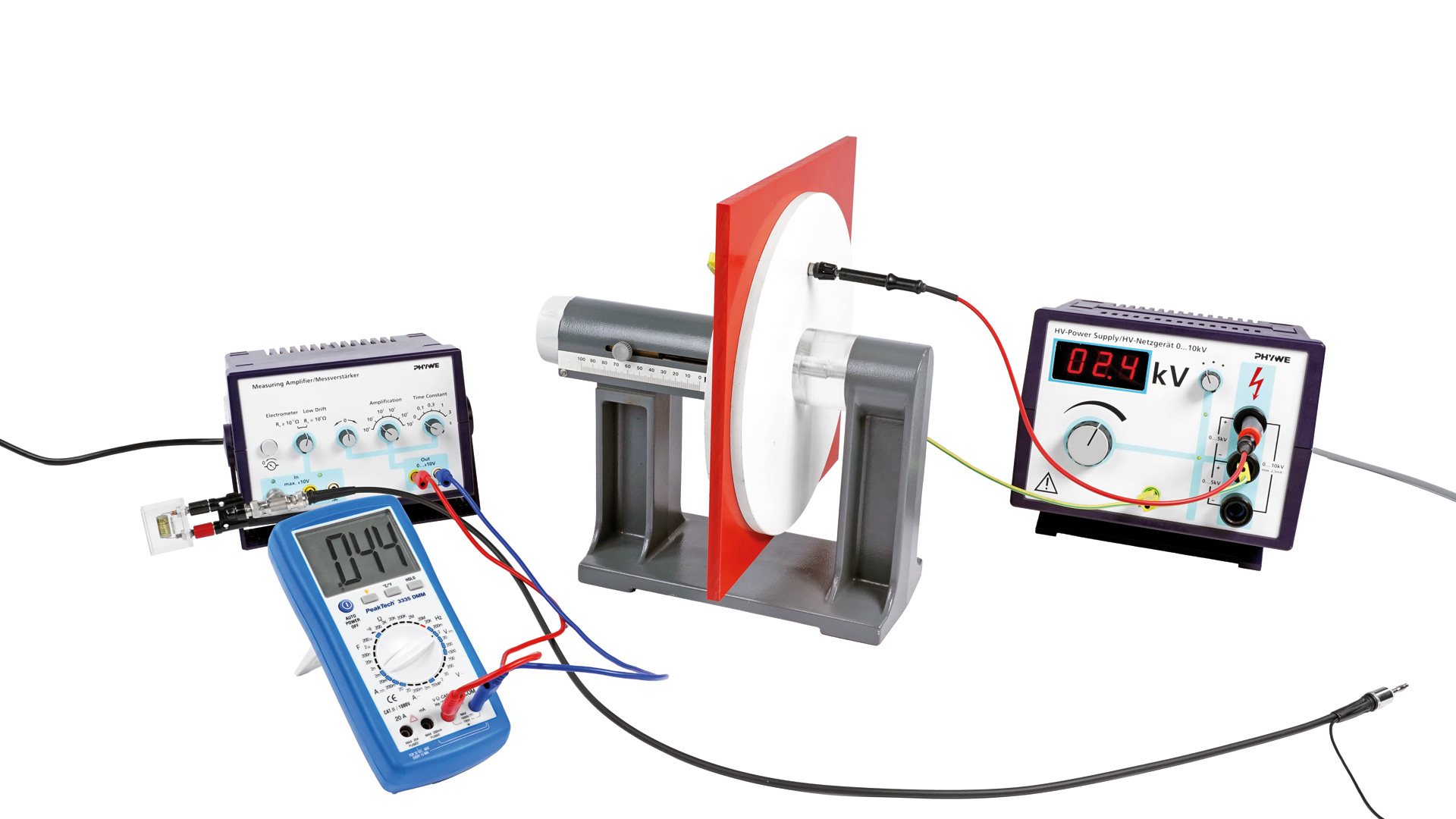
Dielectric constant of different materials
Article No: P2420600
The electric constant is determined by measuring the charge of a plate capacitor to which a voltage is applied. The dielectric constant is determined in the same way, with plastic or glass filling the space between the plates. Benefits Supplies non-hazardous high voltage Easy experimental set-up due to clear and compact design Clever investment: The included universal measuring amplifier can also be used for other applications Tasks The relation between charge Q and voltage U is to be measured using a plate capacitor. The electric constant is to be determined from the relation measured under point 1. The charge of a plate capacitor is to be measured as a function of the inverse of the distance between the plates, under constant voltage. The relation between charge Q and voltage U is to be measured by means of a plate capacitor, between the plates of which different solid dielectric media are introduced. The corresponding dielectric constants are determined by comparison with measurements performed with air between the capacitor plates. Learning objectives Maxwell's equations Electric constant Capacitance of a plate capacitor Real charges Free charges Dielectric displacement Dielectric polarisation Dielectric constant