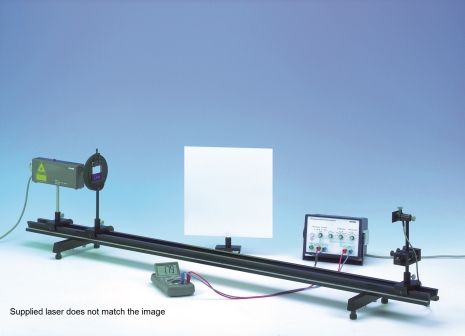
Diffraction intensity due to pin holes and circular obstacles
Article No: P2230301
Pin hole diaphragms and circular obstacles are illuminated with laser light. The resulting intensity distributions due to diffraction are measured by means of a photo diode. Tasks The complete intensity distribution of the diffraction pattern of a pin hole diaphragm (D1 = 0.25 mm) is determined by means of a sliding photo diode. The diffraction peak intensities are compared with the theoretical values. The diameter of the pin hole diaphragm is determined from the diffraction angles of peaks and minima. The positions and intensities of minima and peaks of a second pin hole diaphragm (D2 = 0.5 mm) are determined. The diffraction peak intensities are compared with the theoretical values. The diameter of the pin hole diaphragm is determined. The positions of minima and peaks of the diffraction patterns of two complementary circular obstacles (D*1 = 0.25 mm and D*2 = 0.5 mm) are determined. Results are discussed in terms of Babinet's Theorem. Learning objectives Huyghens principle Interference Fraunhofer and Fresnel-diffraction Fresnel's zone construction Coherence Laser Airy disk Airy ring Poissonâ's spot Babinet's theorem Bessel functions Resolution of optical instruments