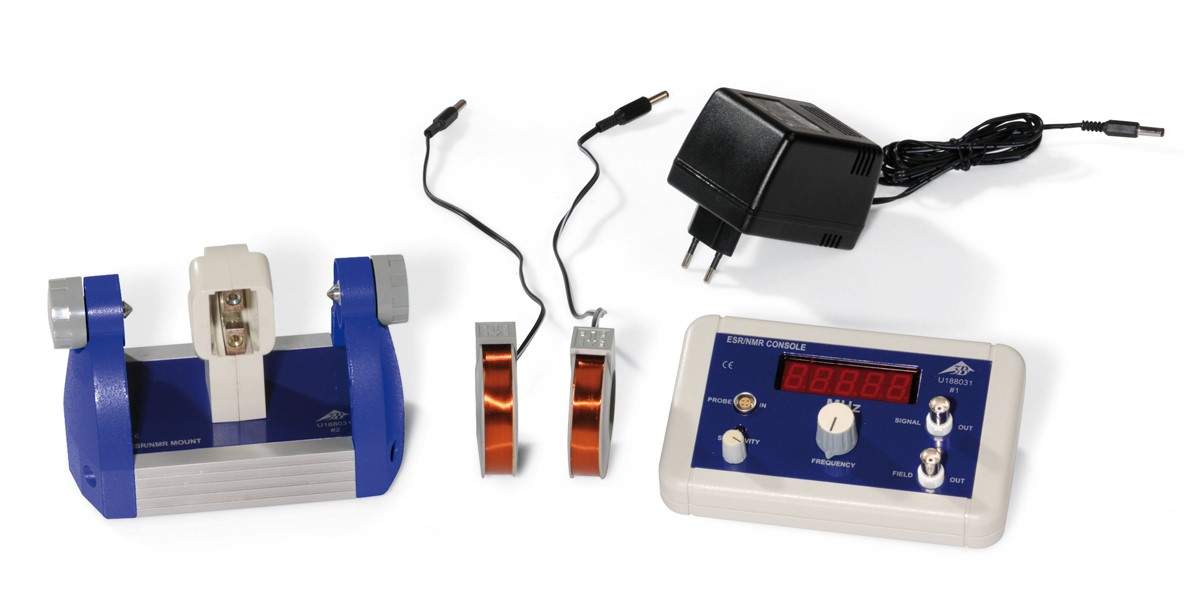
Electron spin resonance
Article No: P2511201
Unknown Principle With electron spin resonance (ESR) spectroscopy compounds having unpaired electrons can be studied. The physical background of ESR is similar to that of nuclear magnetic resonance (NMR), but with this technique electron spins are excited instead of spins of atomic nuclei. The g-factor of a DPPH (Diphenylpikrylhydrazyl) specimen and the halfwidth of the absorption line are determined, using the ESR apparatus. Benefits Easy and fast experiment setup Tasks Determine the g-factor (Landé-factor) of the DPPH (Diphenylpicrylhydrazyl) specimen. Determine the FWHM (Full Width at Half Maximum) of the absorption line. Learning objectives Zeeman effect Energy quantum Quantum number Resonance g-factor Landé factor