Fine structure: one and two electron spectra
Article No: P2510605
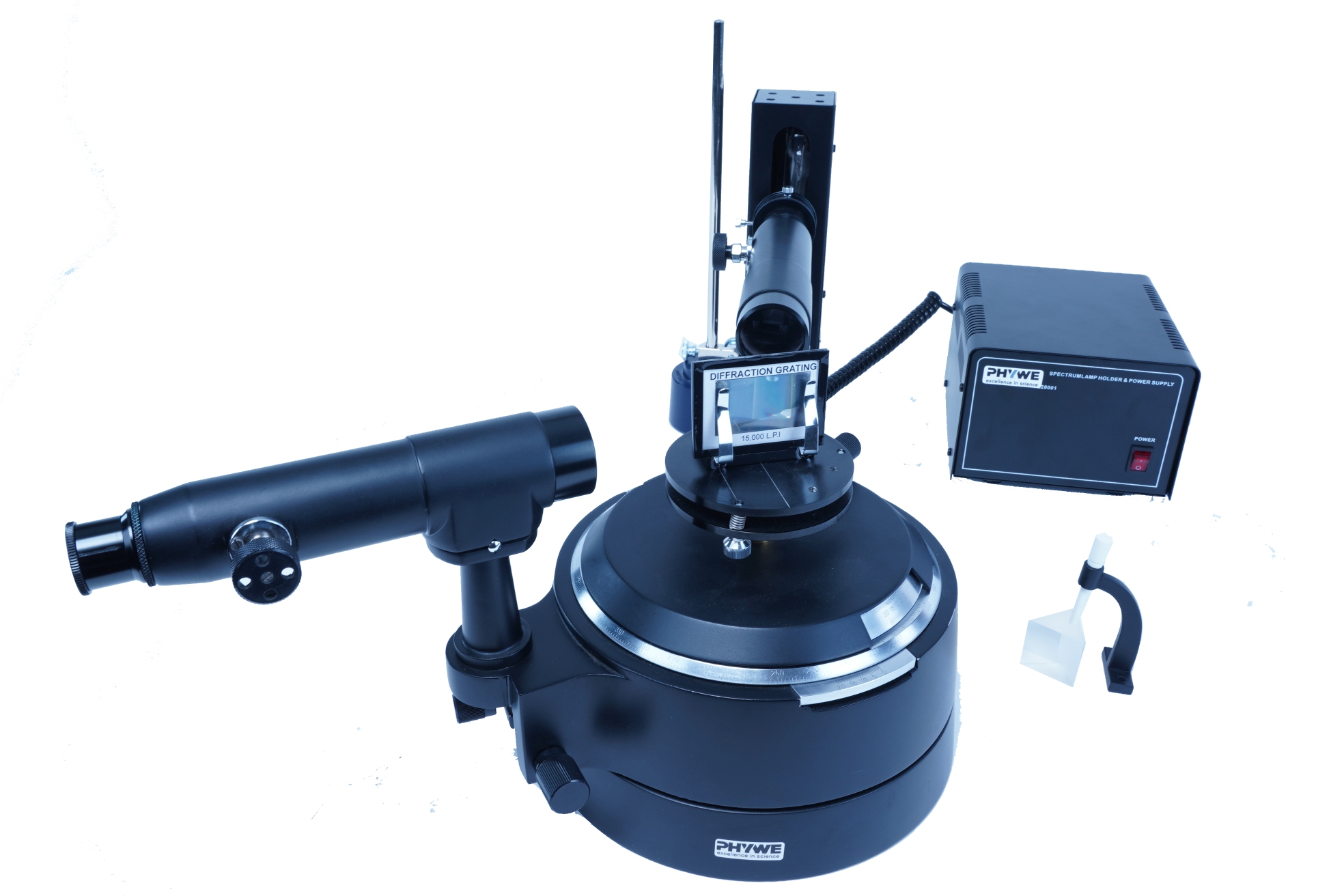
Unknown Benefits Wavelength determination of optical spectra with high precision Simple setup Reading of a nonius Principle To determine the wavelength, a spectrometer-goniometer is used. It consists of a dispersive element, which deflects light through an angle depending on the wavelength, and a goniometer to determine the angle of deflection of the light beam. As dispersive elements a grating and a flint prism are used. In case of single electron spectra the spin-orbit coupling produces doublet spectra. For measuring the splitting of the sodium 2P -levels the in nm-range, double lines from transitions involving these levels are observed with a dispersion grating. For the two electron spectra the transition from LS- to jj-coupling occurring from lighter to heavier elements is of importance, causing "forbidden" lines to appear with the heavier elements having larger atomic number Z. Here weaker lines may be observed using a dispersion prism allowing for less spectral resolution but better visibility because of less stray light. Tasks One-electron spectra: Set up the spectrometer as a grating spectrometer and determine the grating constant using literature values for the visible spectral lines from a helium lamp. With the determined grating constant measure the wavelengths of the observable sodium spectral lines belonging to the split 3 ²P level, determine the energy difference between the 3 ²P1/2 and 3 ²P3/2 level Two-electron spectra: Set up the spectrometer as a prism spectrometer and determine the dispersion function of the flint prism using literature values for the visible spectral lines from a helium lamp. Determine the wavelengths of spectral lines of zinc, cadmium, and mercury. Observe the increase of triplet-singulet transitions with increasing atomic number. Learning objectives Grating and prism spectrometer Energy level Excitation energy Selection rules for optical transitions Electron spin Orbital angular momentum Spin magnetic moment Orbital magnetic moment Spin-orbit interaction Multiplicity Doublets Para-helium Ortho-helium Exchange energy Singlet series Triplet series Forbidden transitions