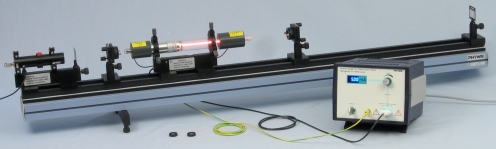
Helium Neon laser, basic set
Article No: P2260701
The difference between spontaneous and stimulated emission of light is demonstrated. The beam propagation within the resonator cavity of a He-Ne laser and its divergence are determined, its stability criterion is checked and the relative output power of the laser is measured as a function of the tube's position inside the resonator and of the tube current. Benefits Set up and run a laser, that is by now classic, from its constituting elements Get a feel for the delicate adjustments necessary to achieve lasing conditions Dicover the way many parameters can influence the output of this gas laser Tasks Set up the He-Ne laser. Adjust the resonator mirrors by use of the pilot laser (left mirror: VIS, HR, plane; right mirror: VIS, HR, R = 700 mm). Check on the stability condition of a hemispherical resonator. Measure the integral relative output power as a function of the laser tube's position within the hemispherical resonator. Measure the beam diameter within the hemispherical resonator right and left of the laser tube. Determine the divergence of the laser beam. Measure the integral relative output power as a function of the tube current. The He-Ne laser can be tuned using a BFT or a LTP. Learning objectives Spontaneous and stimulated light emission Inversion Collision of second type Gas discharge tube Resonator cavity Transverse and longitudinal resonator modes Brewster angle