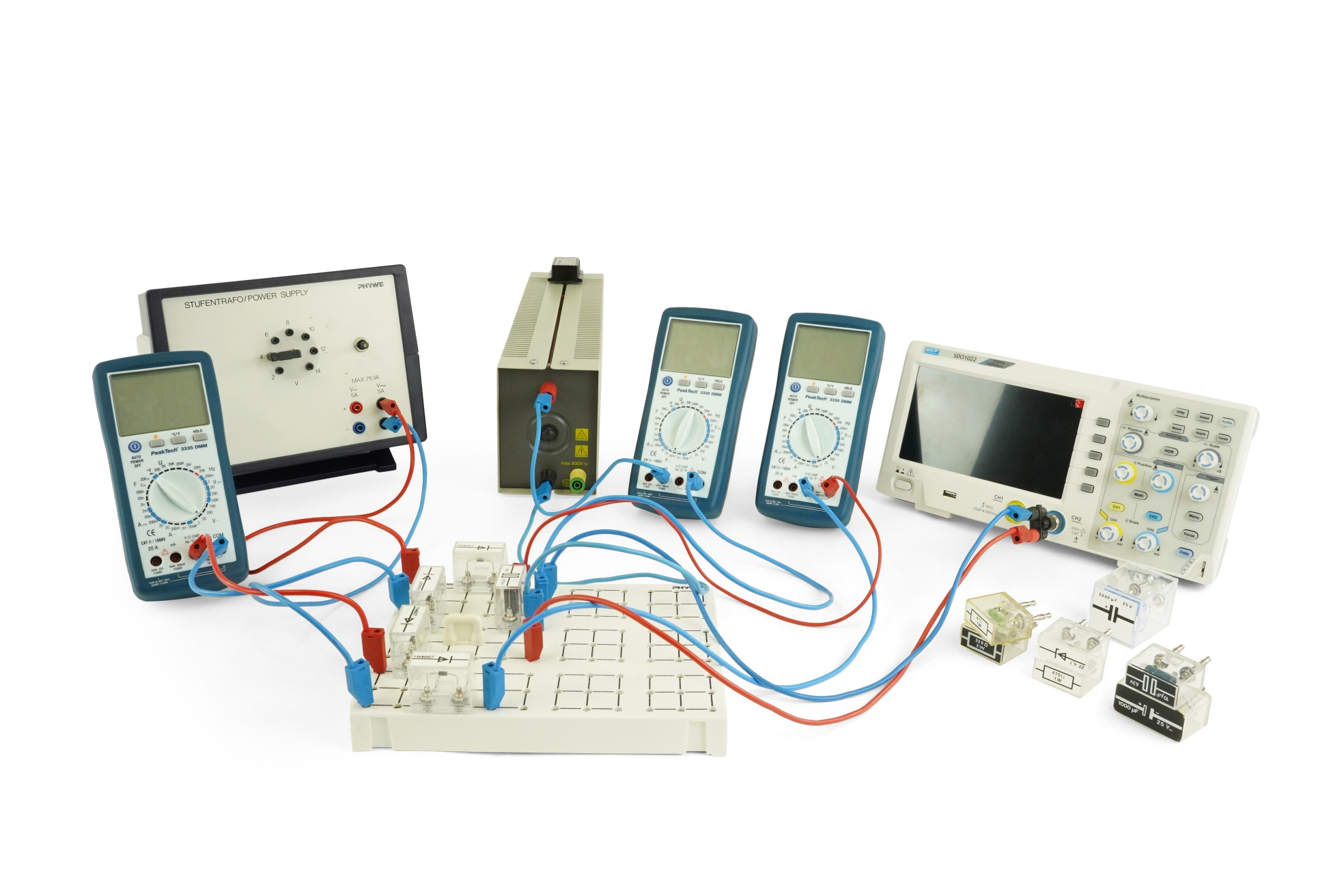
Rectifier circuits
Article No: P2440700
The ripple of the output voltage of various rectifier circuits is measured as a function of the load current strength and the charging capacitance. The characteristics of a voltage stabilizer and of a multiplier are investigated. Benefits Get to know several types of rectifier circuits Suitable for vocational classes Tasks Using the half-wave rectifier: To display the output voltage (without charging capacitor) on the oscilloscope. To measure the diode current I_d as a function of the output current strength I_0 (with the charging capacitor). To measure the ripple component U_ACpp of the output voltage as a function of the output current (C=constant). To measure the ripple as a function of the capacitance (I_0=constant). To measure the output voltage U_0 as a function of the input voltage U_i (I_0=0). Using the bridge rectifier: To display the output voltage (without charging capacitor) on the oscilloscope. To measure the current I_d through one diode as a function of the output current I_0 (with the charging capacitor). To measure the ripple of the output voltage as a function of the output current (C=constant). To measure the ripple as a function of the capacitance (I_0=constant). To measure the output voltage as a function of the input voltage. To measure the voltage U_c at the charging capacitor, and the output voltage of a stabilised voltage source as a function of the input voltage U_i. To measure the output voltage of a voltage multiplier circuit as a function of the input voltage. Learning objectives Half-wave rectifier Full-wave rectifier Graetz rectifier Diode and Zener diode Avalanche effect Charging capacitor Ripple r.m.s. value Internal resistance Smoothing factor Ripple voltage Voltage stabilisation Voltage doubling