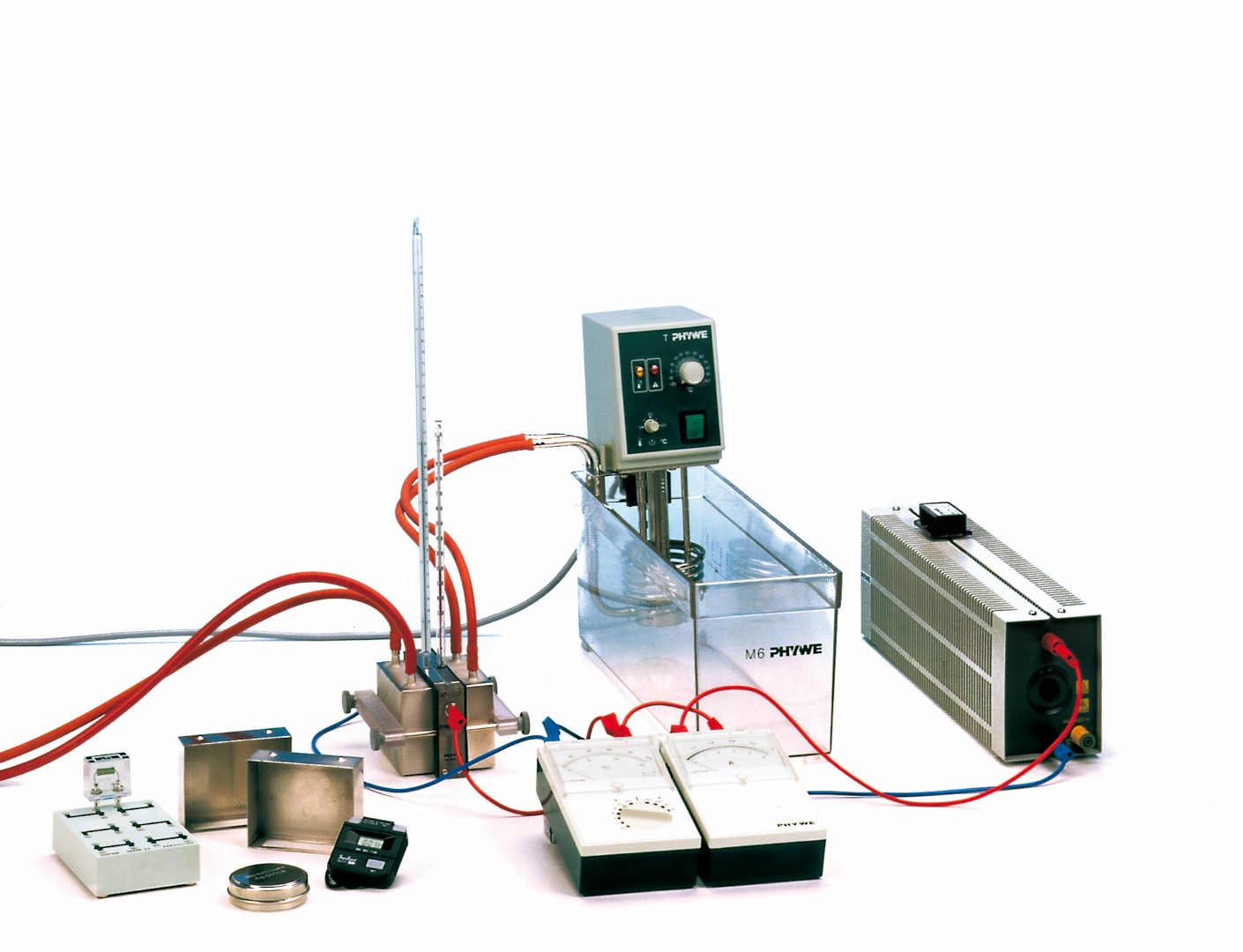
Semiconductor thermogenerator - Seebeck effect
Article No: P2410700
In a semi-conductor thermogenerator, the no-load voltage and the short-circuit current are measured as a function of the temperature difference. The internal resistance, the Seebeck coefficient and the efficiency are determined. Benefits Open design allows to fully understand function and applications Individual instruments for distinct functions (no "black box") Key products of the experiment setup can also be used for investigating the Peltier effect Tasks To measure no-load voltage U0 and short-circuit current Is at different temperature differences and to determine the Seebeck coefficient. To measure current and voltage at a constant temperature difference but with different load resistors, and to determine the internal resistance Ri from the measured values. To determine the efficiency of energy conversion, from the quantity of heat consumed and the electrical energy produced per unit time. Learning objectives Seebeck effect (thermoelectric effect) Thermoelectric e.m.f. Efficiency Peltier coefficient Thomson coefficient Seebeck coefficient Direct energy conversion Thomson equations