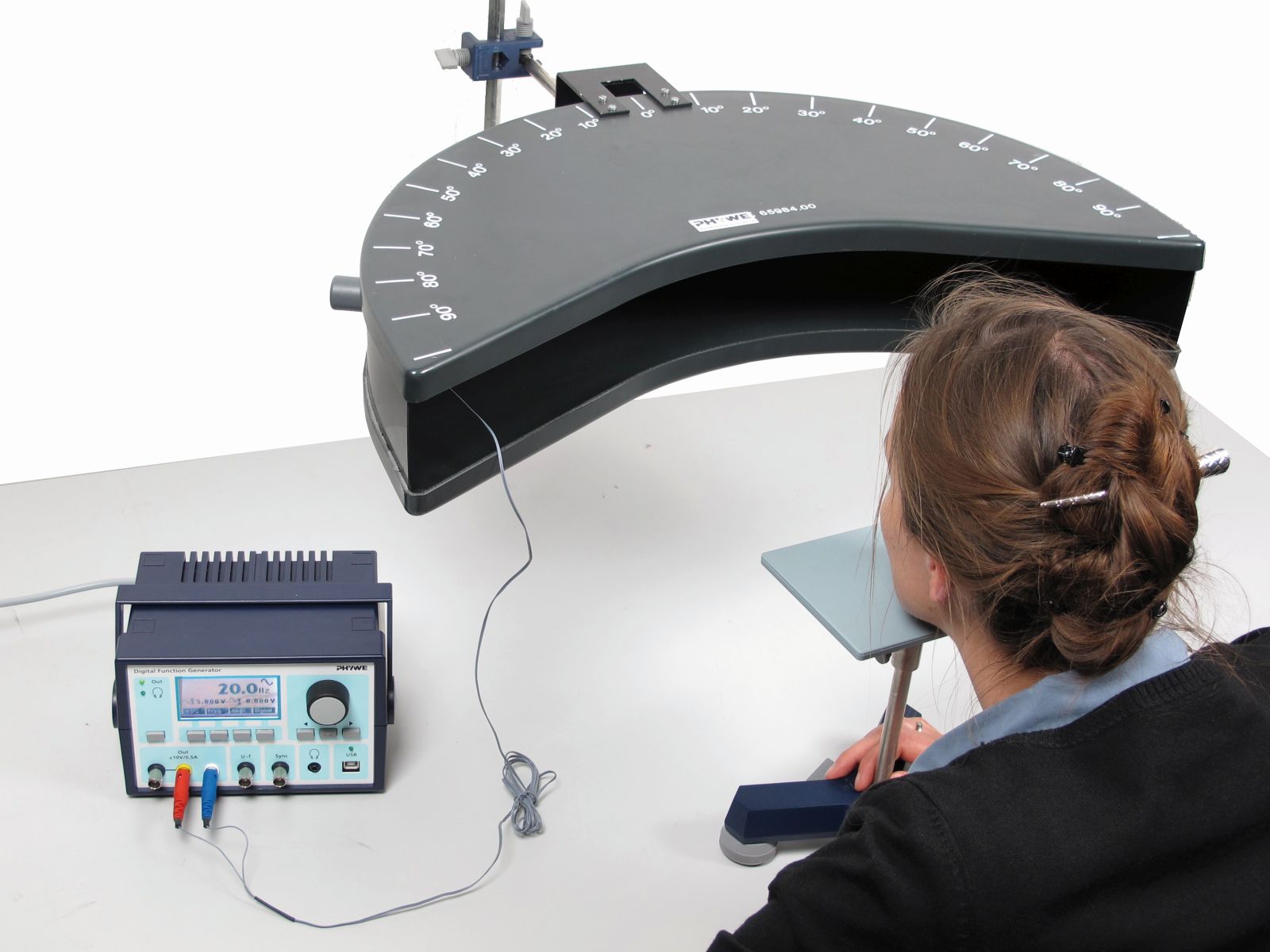
Time resolving capability of the human eye
Article No: P4070300
As excitation of the light-perceptive cells of the retina always takes a little longer than the light stimulus, only a limited number of stimuli per unit of time can be processed (time-related resolving power of the eye). If a light source is switched on and off periodically in increasingly rapid sequence the eye at first perceives the individual flashes, then the appearance of flicker occurs and finally the impression of a continuous light (fusion of the flicker). Benefits Perimeter design semidiagnostic, therefore appropriate for medical education Tasks Determine the flashing frequency of an LED at which the impression of a continuous light just occurs Change the direction of incidence of the light using a perimeter Determine the flicker fusion threshold of the left and right eye in relation to the direction of incidence of light stimulus and the state of adaptation of the eyes. Learning objectives Perimeter Time-related resolving power Flicker fusion frequency Light/dark-adapted eye