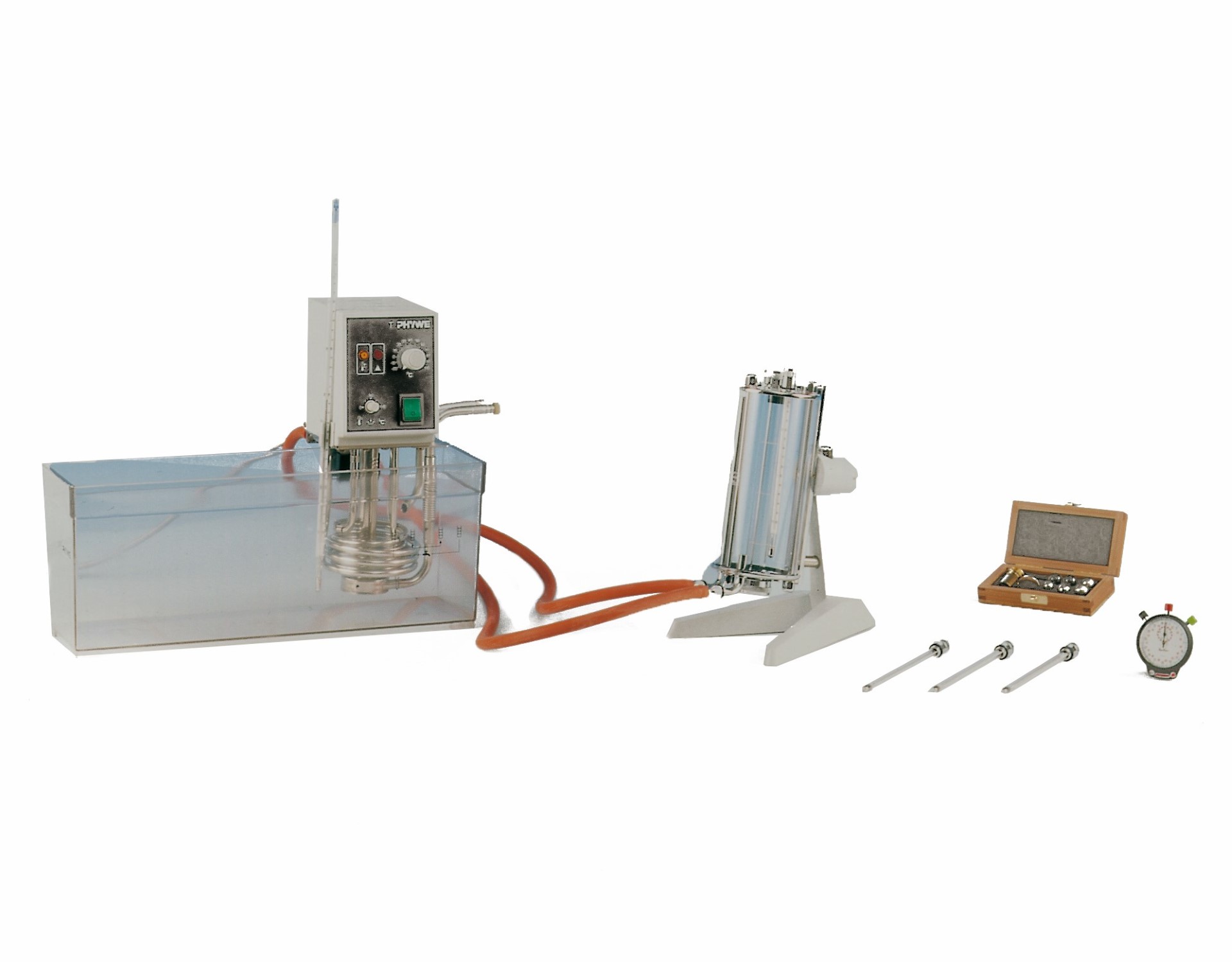
Viscosity measurement with the falling ball viscometer
Article No: P2140400
Due to internal friction among their particles, liquids and gases have different viscosities. The viscosity, a function of the substance's structure and its temperature, can be experimentally determined, for example, by measuring the rate of fall of a ball in a tube filled with the liquid to be investigated. Benefits Viscosity measurement for two fluids and any mix ratio Viscosity measurement for different temperatures possible Angle of falling ball viscometer can be changed Interdisciplinary use also in applied sciences or physical chemistry Tasks Measure the viscosity of methanol-water mixtures of various composition at a constant temperature, of water as a function of temperature and of methanol as a function of temperature. From the temperature dependence of the viscosity, calculate the energy barriers for the displace ability of water and methanol. Learning objectives Liquid Newtonian liquid Stokes law Fluidity Dynamic and kinematic viscosity Viscosity measurements